
















Infusion Tactics: 8 Amazing Ways to Hack Flavor

From the ultra-modern to the most traditional, learn how to bring new flavor to your drinks.
Infusing liquids is an ancient art, but contemporary bartenders have a stunning range of new tools and techniques to transform flavor, texture, and aroma.
If you want to master the art of infusion, it’s critical to understand not only how these techniques work, but when to use them.
To help you on your path, the Academy Bar Team in NYC has shared some of their favorite infusion techniques, plus how we’ve used them.
Explore the techniques:
Maceration | Justino | Pour-Over | Fat Wash | Tincture | iSi / Nitro | Sonic / Jewelry Cleaner | Sous Vide
HOW TO MAKE A MACERATION INFUSION
About Maceration Infusions:
Maceration is the easiest and most classic infusion method. All you need is your liquid, ingredients, and time. But like all simple things, mastery lies in understanding the nuance of how all three interact.
Different ingredients, for example, will call for quite different infusion times. Tea creates a great product in half an hour or less, while savory, pungent items like minced onion may need less than five minutes. Items with larger cellular structures (like fruits and vegetables) should go at least overnight, often reaching their full potential in the 48-72 hour range.
We strongly recommend tasting as you go while dialing your recipe! You may discover a more subtle infusion is the right choice for the application, but it will also help you benchmark infusion times for future projects.
Maceration Pros
- Maceration creates an authentic and nuanced product. Rather than simply layering flavors, it feels like a fully integrated liquid.
- Works well with a broad range of ingredients and liquids.
- Dehydrate and blend your ingredient (after infusion) to create a powder or salt for a fully closed-loop process. This works specifically well with fruit.
Maceration Cons
- Timing is huge consideration: Under-extract, and you get very little flavor. Over-extract, especially with the wrong ingredient, and you’ll overpower the spirit or pull out unpleasant bitter notes. Environmental factors like temperature can also impact.
- Shelf Life: Fresh fruit and other limited shelf-life ingredients do not create shelf-stable infusions. Fruit infusions, in best practice, should be stored refrigerated to reduce flavor loss.
- Cosmetic consideration: Macerated infusions can create a cloudy product.
- Product consistency can vary significantly. Jalapeño-infused tequila is the classic example you’ve probably experienced. Batch to batch (or even pepper to pepper), spice levels can vary widely, and consequently, so can your infusions, if you’re not checking.
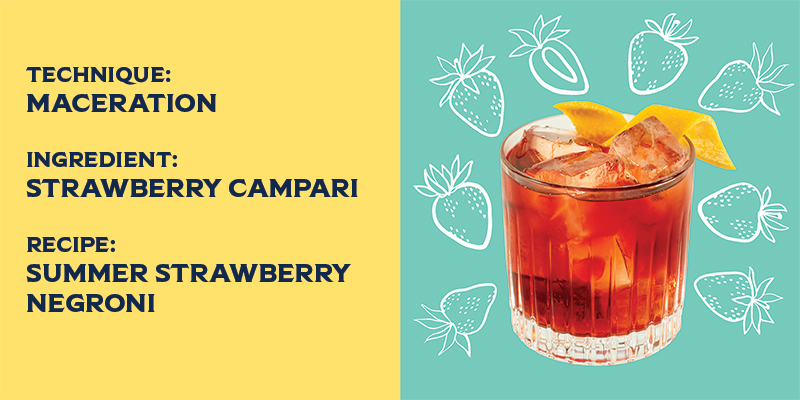
Recipe: Strawberry-Infused Campari
This simple fruit maceration brings out a jammy fruit quality to Campari with no discernible change to mouthfeel and only a marginal brix increase.
Ingredients
- 3 cups Strawberries (quartered)
- 750 ml Campari
Tools
- Non-reactive container (eg. Cambro, plastic deli container)
- Strainer
- Time
Instructions
- Let sit for 1-3 days, tasting as you go. (Longer infusions are usually recommended for fresh fruits in particular.)
- Store refrigerated (perishable).
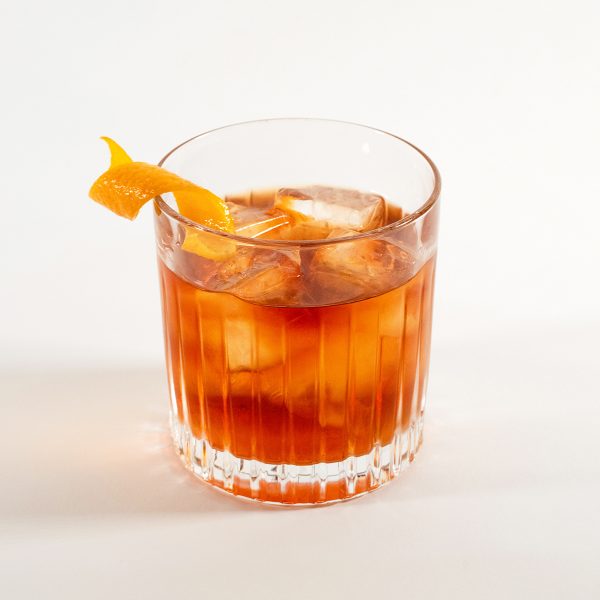
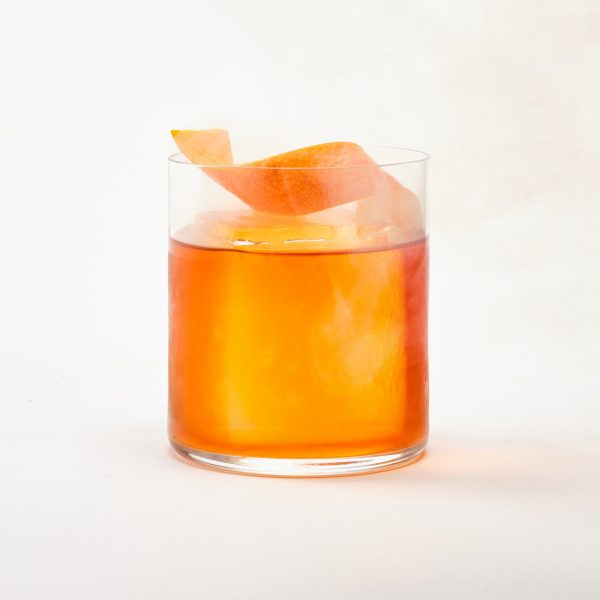
Try It In: Summer Strawberry Negroni
The Strawberry Campari shines here, creating a bright and summery Negroni that is slightly sweeter than the original, making it a great introduction for new Negroni drinkers.
Ingredients:
- 1 oz Strawberry-Infused Campari
- 1 oz Bulldog Gin
- 1 oz Sweet Vermouth
Instructions
- Stir all ingredients with ice and strain into a chilled rocks glass over fresh ice.
- Garnish with a strawberry slice and an orange twist.
HOW TO MAKE A JUSTINO INFUSION
About Justino Infusions
Another weird and wonderful concept from the Dave Arnold idea factory, Justino is a techy, modernist tactic for infusing your spirit with low-water ingredients that would be difficult to juice traditionally, such as dried figs, dates, raisins, or bananas.
It’s both a process and tool-heavy technique, but it allows us to capture a complete flavor profile while maintaining both clarity and an elegant texture. If your bar program involves centrifuges and bulk orders from Modernist Pantry, definitely give this one a try!
We particularly like the Justino for dried fruits because they contribute concentrated sweetness, caramelized fruit notes, and aroma without significantly diluting the base spirit. After clarification, evaluate sweetness, acidity, and salinity. Small additions of saline or citrus oil can dramatically improve balance and perception of fruit character.
Justino Pros
- Excellent for hard-to-juice ingredients: such as dried figs, dates, raisins, bananas, and other dense or dried fruits.
- Clarity & Intensity: Produces a clear spirit with intense fruit character and aroma without adding significant pulp, haze, or heavy texture.
Justino Cons
- Requires specialized (and pricey) equipment and ingredients.
- Yield loss is inevitable, as a portion of the spirit remains trapped within the solids after spinning.
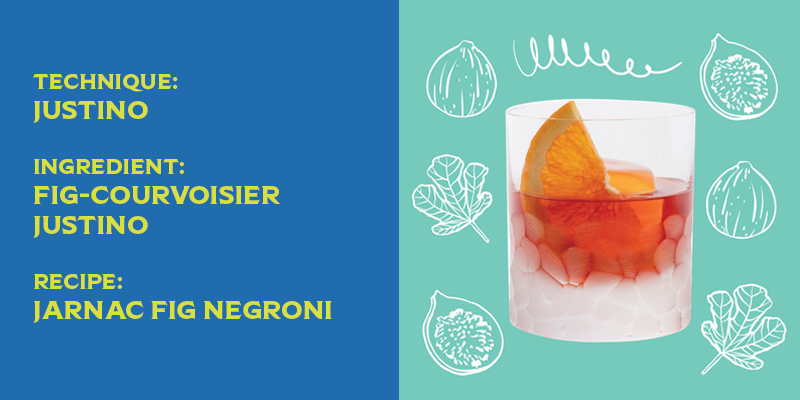
Recipe: Fig-Cognac Justino
Produces a crystal-clear Cognac carrying rich fig aromatics, dried fruit complexity, honey, caramel, and dark stone fruit notes. Fresh fig aromas lead, followed by dried fig, raisin, honey, and subtle baking spice notes that naturally complement the grape and oak character of Courvoisier.
The mouthfeel remains lighter and more elegant than a traditional infusion, with a light increase in perceived sweetness compared to base Cognac. Refrigerated shelf life is generally several weeks or longer due to clarification and alcohol content.
Ingredients
- 200 g Dried Figs
- (This is roughly how much you’ll want per liter for most dried/low water fruits and vegetables)
- 1 L Courvoisier
- 4 ml Pectinex
- 8 ml Kieselsol
- 4 ml Chitosan
Tools
- Vitamix or high-powered blender
- Spinzall 2.0
- Fine mesh strainer
- Scale
- Cambro or mixing vessel
- Measuring pipette for Pectinex
Instructions
- Add 4ml Pectinex, 4ml Kieselsol, dates, and Courvoisier to Vitamix.
- Blend on high until the mixture is physically warm to the touch. Pour into a non-reactive container and let sit 15 Minutes.
- Add 4ml Chitosan and stir to incorporate. Wait 15 minutes minimum.
- Add 4ml Kieselsol and stir again. Wait 15 minutes and decant into Spinzall 2.0.
Try It In: Jarnac Fig Negroni
The fig character has become part of the Cognac itself rather than an modifying addition. This concentrated fruit flavor shines without cloudiness or weight, resulting in a remarkably clean and luxurious Negroni.
Ingredients
- 1 oz Courvoisier Fig Justino
- 1 oz Campari
- 1 oz Sweet Vermouth
Instructions
- Stir all ingredients with ice until chilled and diluted.
- Strain over a large ice in a rocks glass. Garnish with orange twist.
HOW TO MAKE A POUR-OVER INFUSION
About Pour-Over Infusions:
The pour-over method allows you to extract flavor from finely ground ingredients that would otherwise over-infuse in a traditional maceration (or be a pain to strain out of your liquid).
Pros
- Using this method, a lighter infusion can be achieved. This is one of the more restrained infusion techniques.
- Speed: This is an extremely fast infusion with high aroma.
- Ease: Of all the methods, this is one of the most easily replicable in both technique and result.
- Ingredient Adaptive: This technique works with much more than coffee. We have also experimented with intense teas and ground aromatic spices to great result.
Cons
- Missing Notes: The inherent speed of the technique means more complex notes may be missed.
- Mileage Varies: There is no set amount for every ingredient; you don’t need much coffee, black pepper, or curry powder for example. Less intense flavors such as amchur, though, may call for a larger amount of the base ingredient.
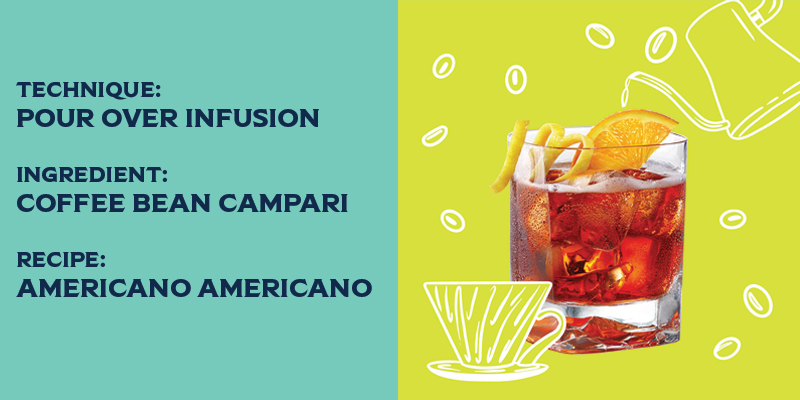
Recipe: Coffee-Infused Campari
A quick coffee pour yields an eye-opening ingredient to anchor this riff on the low-proof classic.
Ingredients
- 750 ml Campari
- 60 g Ground Coffee
Tools
- Coffee filter
Instructions
- Add coffee grounds to a coffee filter and pour Campari very slowly over the grounds, allowing the liquid to soak up coffee before dripping down.
- Strain if necessary and bottle.
Recipe: Americano Americano
Bright coffee notes add complexity to this paired down classic.
Ingredients
- 1.5 oz Coffee Infused Campari
- 1.5 oz Sweet Vermouth
- 4 oz Club Soda
Instructions
- Build in a Highball glass over ice.
- Garnish with orange twist.
HOW TO MAKE A FAT WASH INFUSION
About Fat Wash Infusions:
Originally developed at NYC’s PDT in the mid-2000s using bacon (watch our class with Don Lee about…everything), this technique is a great way to incorporate both texture and flavor into what otherwise would not be easily infused/soluble.
Pros
- Works with a broad range of ingredients. Anything with fat or dairy can be used to wash a spirit, meaning the end products are infinite. You can even infuse flavors into your fat first, as in this Sage Butter Martini.
- Relatively simple and repeatable methodology
- Opportunity to utilize (or re-use) ingredients from the kitchen
Cons
- Requires time and space. The infusion needs to sit at least overnight in the freezer to rise and freeze at the top of the spirit.
- If not strained properly, the final product can turn out quite cloudy.
- Not shelf stable.
- Difficult to standardize/replicate between fat sources.
- Typically, we shoot for between 15-20% infusion material to spirit, but depending on the fat content and the pungency of the medium, it may need to be adjusted.
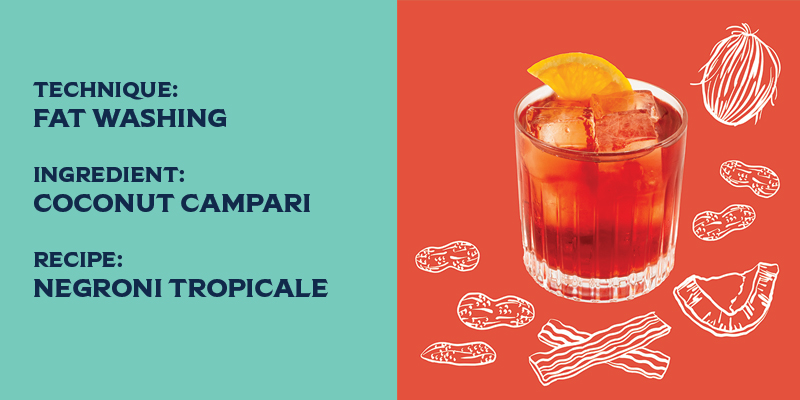
Recipe: Coconut Campari
Fat washing Campari produces a new liquid with no visible change, but a richly texture and evocative, beachy aroma.
Ingredients
- 120 g melted Virgin Coconut Oil
- 750 mL Campari
Tools
- Heat Source
- Non-reactive container
- Freezer
- Chinois
- Filtration Method: cheesecloth, coffee filter, or superbag
Instructions
- Gently melt the coconut oil until fully liquid.
- Combine 750ml Campari and 150ml liquid coconut oil in a sealable container.
- Stir or shake thoroughly to fully incorporate the oil.
- Allow mixture to rest at room temperature for ~4 hours.
- Place container in freezer overnight, or until the coconut oil forms a completely solid layer.
- Remove the solid fat cap and discard.
- Strain through a fine mesh strainer.
Try It In: Negroni Tropicale
This modern classic by Kevin Diedrich is a Negroni that will make you think you’re under the palm trees. A touch of passion fruit pairs well with the aroma and mouthfeel of the Coconut Campari to create a light and crushable cocktail.
Ingredients
- 1 oz Bulldog Gin
- 1 oz Sweet Vermouth
- 1 oz Coconut Fat-Washed Campari
- .25 oz Passion Fruit Liqueur
Instructions
- Add all ingredients to a mixing glass with ice and stir.
- Strain over a large rock in a rocks glass. Garnish with orange twist.
HOW TO MAKE A TINCTURE INFUSION
About Tincture Infusions
Tinctures are an excellent way to capture flavor and can be utilized in a number of ways. At the most basic level, it is simply using a neutral high-proof spirit to extract flavor.
We are using high ABV spirit here because our goal is to extract only the beautiful top notes and essential oils of citrus peel. In a hydro-alcoholic solution, higher ABV extracts oils. At lower proof, tannin and earthier notes come through.
AB is also important consideration for time: A lower proof base spirit often requires a longer infusion, which has the potential to extract unwanted secondary flavors from certain items.
Tinctures can be used in several ways. The highly concentrated flavor means you can add nuance with only dashes or drops. Make sure to keep an eye on your tinctures and taste them regularly, to achieve the level and balance of flavor you are aiming for.
Pros
- Great level of control over the amount of flavor added.
- Endlessly customizable. Most ingredients can be made into tinctures very easily.
- The solubility of certain flavor compounds and oils work best at high ABV.
Cons
- Some ingredients are naturally quite bitter, volatile, or astringent. Concentrating these flavors can lead to unpalatable tinctures.
- Because there is no set golden ratio for every ingredient, a fair amount of guess-and-check is necessary to create great tinctures.
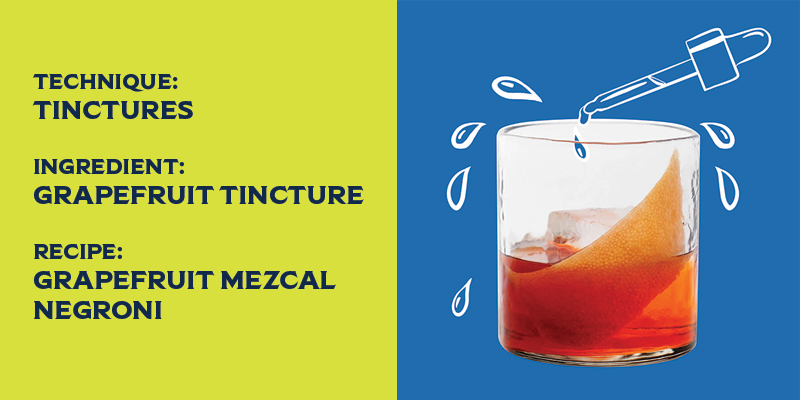
Recipe: Grapefruit Tincture
Extraction is evident almost immediately and the flavor is quite striking.
Ingredients
- 20 g Grapefruit zest (zest of ~2 grapefruits)
- 4 oz Everclear
Tools
- Pint container
- Strainer
- Time
Instructions
- Combine ingredients, stir, and let sit. For citrus zest, a 15 minute steep will do.
- Strain and bottle.
Try It In: Grapefruit Mezcal Negroni
Bright grapefruit shines through in what would otherwise be a very simple Negroni. Our tincture adds bright, oily citrus notes that pair with mezcal perfectly.
Ingredients
- 1 oz Montelobos Espadin Mezcal
- 1 oz Campari
- 1 oz Sweet Vermouth
- 4 dashes Grapefruit Tincture
Instructions
- Add all ingredients to a mixing glass with ice and stir.
- Strain into a rocks glass over ice. Garnish with lime twist.
HOW TO MAKE A RAPID N20 CANISTER INFUSION
About Rapid Nitro Infusions:
With porous or dried ingredients such as ginger, spices, teas, roots, and dehydrated fruits, the gas canister allows for a much more uniform, efficient, and rapid infusion than regular maceration of the same ingredients.
The inherently small size of the infusion container somewhat limits this application for larger cocktail programs. We find nitro infusions particularly useful for event bartending, where prep time and space are often limited, but so are the service window and product required.
Pros
- iSi canisters and cream whippers are amazing at achieving rapid infusions of all kinds. Because of the great amount of pressure, flavors are infused almost instantly.
- The canisters can be used in many various ways. With the use of different gases, sparkling drinks, rapid infusions, foams, and creams can all be achieved with relative ease. This is a multi-functional tool for a modern culinary program.
Cons
- These tools can be costly. Stocking specialty gases can be pricey as well.
- Most commercial whippers are made to hold small volumes of liquid. In order to execute this on a larger scale, multiple canisters or more labor will have to be used.
- Because the canisters have many parts, cleanup and losing pieces can both become pain points.
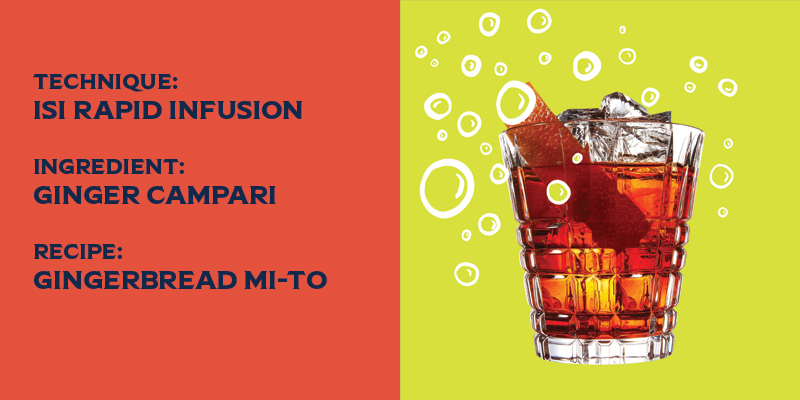
Recipe: Ginger Campari
Ginger’s bright and earthy notes are very present. The infusion is delicious.
Ingredients
- 200 g Sliced Ginger (fresh)
- 400 ml Campari
Tools
- iSi canister
- N2O chargers
- Fine strainer
Instructions
- Place all ingredients into the iSi canister. Screw the lid on tightly, and charge twice with N2O chargers.
- Let sit for 15 minutes. Release the pressure slowly, then open the canister. Fine strain and serve.
- Safety Note: Because the canister is under pressure, be very careful when releasing the gas. A slow release of pressure will ensure that the liquid stays where you want it, instead of on the ceiling!
Try It In: Gingerbread MiTo
This cocktail boasts nostalgic, warming holiday notes that are very satisfying! This no-fuss, easily executable cocktail allows your infusion to really shine.
Ingredients
- 2 oz Ginger-Infused Campari
- 2 oz Sweet Vermouth
- 3 dashes Aromatic Bitters
Instructions
- Add all ingredients to a mixing glass with ice and stir briefly.
- Strain over a large cube in a chilled rocks glass. Garnish with orange twist.
HOW TO MAKE A SONIC INFUSION WITH A JEWELRY CLEANER
About Sonic Infusions:
Sonic infusion uses ultrasonic agitation to accelerate extraction, dramatically reducing the time required to pull flavor from low-moisture ingredients. Cacao nibs are particularly great in this application because they contain highly aromatic compounds that typically require extended infusion times to extract through traditional methods.
We used a standard jewelry cleaner, which you can find online in the $100-300 range.
As with all infusions, small changes in ingredient ratio, temperature, and contact time can significantly impact the final result. Keep detailed notes and test throughout infusion time window to lock in your spec.
Pros
- Excellent for dry ingredients (cacao nibs, spices, and dehydrated botanicals) that benefit from accelerated extraction.
- Most jewelry cleaners have smaller working volumes (ours is 500 ml) but that’s offset by the quick turnaround (under half an hour) and because of the concentrated flavor impact, it can potentially be diluted into a larger batch.
- Produces deep, expressive flavor in a fraction of the time required by traditional maceration.
- Preserves the integrity of the base spirit while efficiently extracting aroma and flavor compounds from the infusion material.
Cons
- Over-extraction can occur quickly, especially with cacao nibs and other bitter ingredients.
- Requires specialized equipment.
- Results may vary depending on the power of the cleaner, vessel size, and liquid temperature, making recipe tracking important.
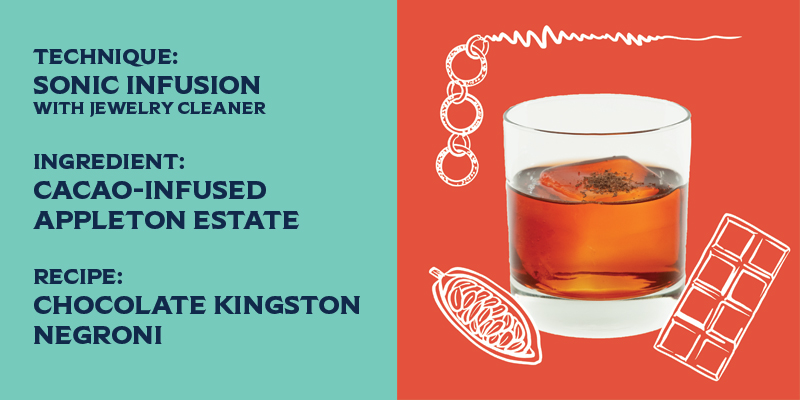
Recipe: Cacao Appleton Estate Signature
Pronounced aromas of dark chocolate, cocoa, roasted nuts, and light baking spice with an increased perceived richness and roundness. There is no significant change in sweetness or proof. Store sealed and away from direct sunlight for optimal flavor retention, but the shelf stability isn’t strongly impacted.
As you dial in your recipe, record both infusion time and cacao quantity. Small adjustments can have a significant impact on flavor extraction and perceived bitterness.
Ingredients
- 750 ml Appleton Estate Signature
- 75 g Cacao Nibs
Tools
- Ultrasonic cleaner (jewelry cleaner)
- Glass jar or vacuum-sealed bag
- Fine mesh strainer
- Coffee filter
- Funnel
- Storage bottle
Instructions
- Combine the ingredients in a glass jar and place jar into an ultrasonic cleaner filled with water.
- Run the cleaner for 30 minutes (maximum). Test at various points if still developing recipe.
- Allow mixture to rest 5-10 minutes and taste.
- If additional chocolate intensity is desired, run an additional 10-15 minute cycle.
- Strain through a fine mesh strainer, followed by a coffee filter to remove fine particles.
- Bottle, label, and store.
Try It In: Chocolate Kingston Negroni
The sonic infusion allows us to maintain the balance and structure of the original, while showcasing and rewiring the interplay of ingredients.
The infusion amplifies the cocoa, baking spice, orange peel, and molasses notes already present in the Jamaican rum, which in highlights Campari’s bitter orange notes and the vermouth’s depth and spice. The cocktail is transformed into something like a decadent, chocolate-covered citrus.
Ingredients
- 1 oz Cacao-Infused Appleton Estate Signature
- 1 oz Campari
- 1 oz Sweet Vermouth
Instructions
- Add all ingredients to a mixing glass with ice and stir.
- Strain over a large cube in a chilled rocks glass. Garnish with orange twist.
HOW TO MAKE A SOUS VIDE INFUSION
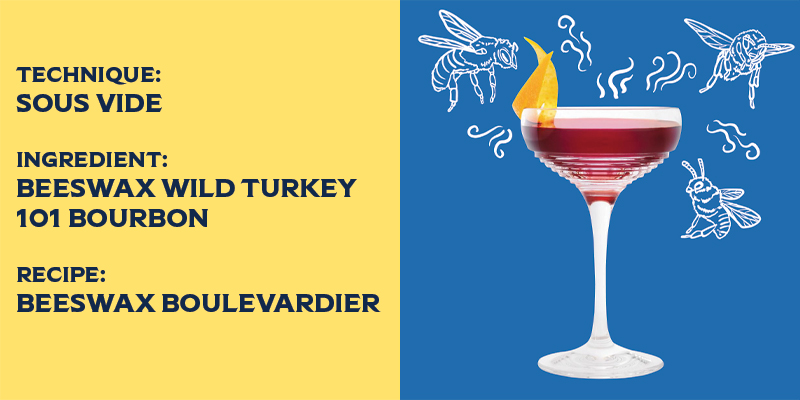
About Sous Vide Infusions:
Some ingredients need heat to break down and infuse. Using a hot water circulator, a constant temperature can be achieved, allowing for consistency in your creations.
The sous vide technique, like many before it, traveled from the kitchen to the bar, where it has enjoyed increasing popularity for good reason. Despite its not insignificant upfront cost, its usage continues to grow as a mid-range tech tool that with a number of applications.
Pros
- Works for any ingredients that need the addition of heat to properly infuse flavors into your liquid.
- A hot water circulator has an extremely wide range of culinary uses. It can be your best friend when it comes to not only infusing liquids, but cooking as well.
- Allows a more precise control of variables like time/temp than traditional methods.
Cons
- Tools required can be prohibitively expensive.
- Requires a fair amount of counter space.
Recipe: Beeswax Infused Wild Turkey 101 Bourbon
The beeswax provides a richer texture and unmistakable notes of honey that make for a luscious infusion.
Ingredients
- 4 oz Beeswax Pellets
- 750 ml Wild Turkey 101 Bourbon
Tools
- Hot water circulator
- Cambro
- Vacuum bags and sealer
- Time
Instructions
- Set your sous vide water circulator in a cambro, and set it to 73C.
- Add the bourbon and beeswax pellets to a vacuum bag (only seal it, don’t vacuum seal) and place in water.
- After 2 hours, remove the bag from the water bath and place it in the freezer for an hour to set.
- Remove bag from freezer. The beeswax will have solidified into hard chunks. Strain the contents through a fine-mesh strainer, and store. This will keep indefinitely.
Try It In: Beeswax Boulevardier
This cocktail uses a series of pretty high-tech methods, but what it yields is truly remarkable. The use of the sous vide method is a game-changer when it comes to creating delicious culinary cocktails.
Ingredients
- 1 oz Beeswax Wild Turkey 101 Bourbon
- 1 oz Campari
- 1 oz Sweet Vermouth
Instructions
- Add all ingredients to a mixing glass with ice and stir.
- Strain into a chilled coupe. Garnish with orange twist.
More Articles

Article
Class Recording: Understanding Drink TextureAdvanced concepts in stabilizers, emulsifiers, carbonation, and beyond!

Article
Class Recording: Negroni R&DTake your Negroni riff from concept to menu with tips from Italian Spirits Ambassador Daniel Kutch.

Article
Class Recording: Lessons From A Pastry ChefMaking stunning garnishes, granitas, and more is easy with these pastry pro tips.
Article
Class Recording: Prep Programs for High-Volume BarsBoost your consistency while lowering costs by designing good systems. Learn how...

Article
USBG National Charity Foundation and Campari present Day of ServiceA nationwide volunteer day for bar pros. Learn how to get involved, key deadlines, and more!
Article
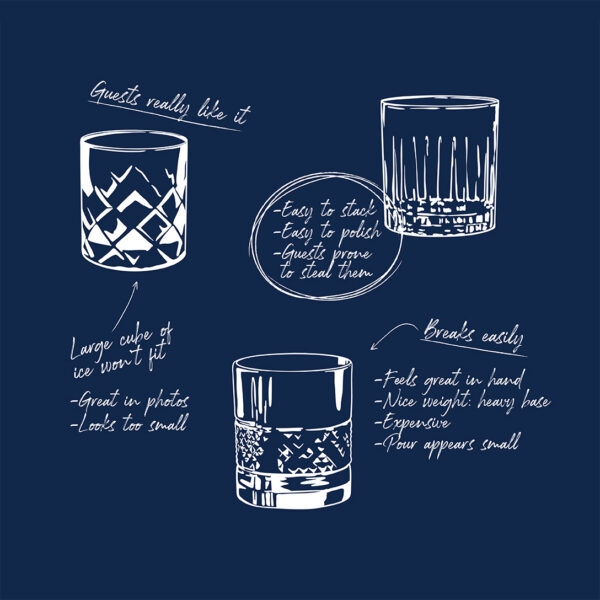
Class Recording: The Secret Life of GlasswareThe right glassware can have a huge impact on your bar's success. Mark Murphy shares a practical guide.
Discover More

Training
Cocktail Strainers ExplainedMany popular cocktails require straining when serving, so cocktail strainers are a must-have bar tool. Read about the 3 main types of cocktail strainers, the differences and when to use each one.

Article
Sam Ross: Why classic cocktails and formulas matterSam Ross, inventor of the Penicillin and the Paper Plane, says formulas make you a better bartender.

Article
Everything Freezes: Class RecordingWant to learn the science, technique, and economics of adding frozen drinks to your bar program? Watch this class recording!
Article
Drink like a local: From Spritz To LimoncelloDiscover the deep rooted history of Italian drinking culture and how it's no 'one size fits all'.